How to Select the Right Cable for Your Application: Complete Expert Guide for the Export Industry
| 22 Dec 2025
Conductors – Typically copper or aluminium, selected based on conductivity, weight, and cost efficiency. Copper conductors deliver excellent conductivity for industrial power cables, while aluminium can reduce weight and cost for large-scale utility projects.
Insulation Materials – PVC, XLPE, PE, rubber, or halogen-free compounds, chosen based on temperature rating, flexibility, and safety. For many export markets, LSZH and fire-performance requirements are increasingly important in public infrastructure and buildings.
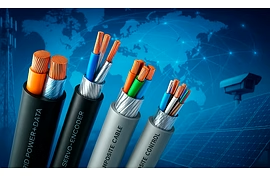
Shielding (Optional) – Braided or foil shielding to protect against electromagnetic interference (EMI) and radio frequency interference (RFI), especially for shielded instrumentation cables and industrial signal cables used in automation environments.
Shielded cables are highly recommended for industrial exports, automation systems, instrumentation, and data communication projects—especially in electrically noisy environments. For global buyers sourcing instrumentation cable exporter options, shielding can significantly improve signal integrity and minimize costly troubleshooting on-site.
Unshielded cables are cost-effective solutions widely used in residential, commercial, and general-purpose electrical exports where interference levels are low. They can be an efficient choice for large-volume projects where compliance and installation simplicity are the primary drivers.
International buyers typically source cable types based on application, regional standards, and installation environment. Below are the most common categories demanded across global infrastructure, industry, and telecom projects.
Power cables are among the most demanded export products for infrastructure, utilities, oil & gas, renewable energy, and construction projects. When selecting industrial power cables, global buyers should prioritize performance, safety, and compliance to avoid shipment rejection or installation failures.
Key export selection criteria• Voltage rating (LV, MV, HV)
• Current-carrying capacity
• Flame-retardant and fire-resistant properties
• Compliance with IEC, BS, or regional standards
Network and data cables are used extensively in telecom infrastructure, IT networks, data centers, and smart buildings. For an ethernet cable supplier serving global projects, consistent performance against international telecom standards is essential for acceptance and reliable operations.
Examples include Cat6, Cat6A, and Cat7 Ethernet cables, as well as fibre optic cables. Many export buyers evaluate bandwidth targets, distance limits, and connector ecosystems to ensure compatibility with deployed equipment.
Selection focus• Data speed and bandwidth
• Frequency rating
• Maximum transmission distance
• International telecom standards
Instrumentation cables are critical for process industries, automation plants, refineries, and power stations, where accurate signal transmission is essential. For buyers sourcing from an instrumentation cable exporter, shielding and chemical resistance often determine long-term stability and reduced downtime.
Selection focus• EMI/RFI shielding
• Twisted pair configuration
• Temperature and chemical resistance
• Stable signal performance for industrial signal cables
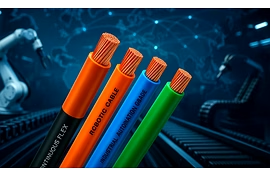
Control cables are used to interconnect PLCs, sensors, motors, and control panels in automated systems. A control cable manufacturer exporter should offer flexible constructions suitable for dynamic installations, along with options for shielding when required.
Selection focus• Flexibility for dynamic installations
• Multi-core configuration
• Voltage rating and shielding
• Durable jacketing for industrial environments
Audio, video, and special application cables are commonly exported for broadcasting, security systems, AV installations, and smart infrastructure projects. For an AV cable exporter, shielding effectiveness and connector compatibility are key factors that influence signal clarity across long runs.
Selection focus• High shielding effectiveness
• Signal clarity and bandwidth
• Connector compatibility
• Compliance for specialized installations
Export cable selection is more than matching a size and voltage. Global buyers and importers should validate environmental fit, certifications, safety ratings, and logistics considerations to ensure smooth customs clearance and reliable performance at the destination site.
Export cables must withstand diverse environments, often far from the point of supply. Selecting export-grade insulation and jacketing helps ensure long service life and international acceptance.
• High-temperature industrial zones
• Outdoor and UV exposure
• Chemical or oil-prone areas
• Moisture and humidity
Compliance is critical in export markets. Many projects require documented alignment to recognized specifications and third-party approvals. Non-compliance can lead to customs delays, shipment rejection, or rework at the installation site.
• IEC, BS, DIN, or ANSI specifications
• UL, CE, CSA approvals
• RoHS and REACH compliance
• Fire performance standards (LSZH, FR, FRLS)
Exported power and control cables must meet or exceed system voltage requirements, load current capacity, and thermal and safety margins. This helps ensure safe operation across different regional power systems and installation practices.
Export cable selection also involves practical shipping and installation realities. Long distances can increase signal attenuation, and improper packaging can cause damage that only becomes visible during installation.
• Signal attenuation over long distances
• Drum or coil packaging suitability
• Mechanical protection during shipping
While competitive pricing matters, export buyers value consistent quality, long operational life, and reduced maintenance and downtime. High-quality export cables deliver better lifecycle value—not just a lower upfront cost.
For importers comparing multiple electrical cable export suppliers, consider total cost of ownership, warranty terms, and evidence of routine batch testing.
Strong export outcomes come from aligning manufacturing, documentation, packaging, and installation guidance. These best practices help reduce compliance risks and ensure smoother commissioning for international projects.
✔ Manufacture as per buyer-specified standards
✔ Ensure clear technical datasheets and test certificates
✔ Use export-grade packaging and labeling
✔ Follow recommended installation practices (bend radius, pulling tension)
✔ Ensure proper grounding and bonding
✔ Provide documentation for customs and compliance audits
Incorrect cable selection in export projects can result in project delays, compliance failures, equipment malfunction, safety hazards, and loss of client trust. A well-informed selection strategy improves acceptance across international markets and supports repeat business.
For EPC contractors and distributors, aligning specifications early and verifying compliance documentation can be the difference between smooth delivery and costly rework.
As a global cable supplier, Agilon Cables supports international customers with export-quality power, control, instrumentation, and data cables, along with custom-designed solutions aligned to global standards.
• Export-quality power, control, instrumentation, and data cables
• Custom-designed cables as per global standards
• Technical support and application guidance
• Reliable logistics and export documentation
We help importers, EPC contractors, and distributors meet international performance and compliance requirements with confidence.